No one stays dead
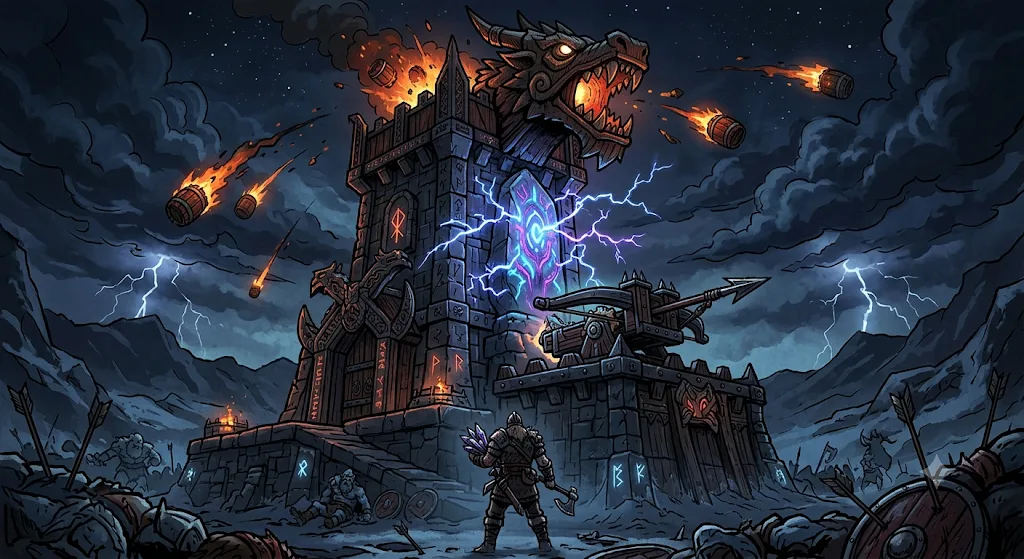
Since the first post the same question has come back to me in one form after another: fine, endless waves and a tower, but what is the actual story? That is a completely fair thing to ask. So far I have only described the shape HoldStrong has, and never what is going on inside it. So this one is about nothing but the narrative. There is barely any mechanics talk in it, and a handful of the things in here have not been written down anywhere public before.
The night the ice started walking
The Eternal Ice has always been up there. Every map of the far north ends at its edge, and for as long as anyone has bothered to keep count, no Viking who walked into it has ever walked back out. None of that is news. It is simply the shape the north has always had: a border you do not cross, and one you had better not think about for too long.
What is new is that the border has started moving.
It began with an eclipse, on a night when every planet in the sky stood in a single line. That alignment only comes around once every five thousand years. Whatever happened up there, the ice has been advancing ever since. It is no longer a place at the end of the map, but a thing coming down towards everything that lives below it.
I am deliberately careful with the question of what the ice actually is. The temptation with a threat this size is to build it a throne and sit a villain on top of it. The Eternal Ice has neither. No kingdom behind it, no council of frost lords, nobody who could be reasoned with. The creatures you fight are things it manifests, not soldiers it commands. It wants nothing you would recognise as wanting. It simply comes closer.
That turns out to be useful well beyond the fiction, because it lets the difficulty curve tell a story instead of just counting. A later wave is then not a slider somebody nudged upwards in a config file, but simply the ice arriving. The light goes colder, the view gets shorter, and the ground you are standing on likes you rather less than it did an hour ago.
What the tower is really made of
Every roguelite has to answer the same awkward question sooner or later: if you died, why do you still have your upgrades? Most games answer that with a shrug and a currency. I wanted an answer that was already sitting in the source material instead, and the one I found is the part of this game I am proudest of.
Odin’s favour does not grant you strength. It grants you permission to take something out of the hall.
Every morning the Einheri is sent back down, one of the fallen from Odin’s hall. And he does not go empty-handed. An axe comes off the wall. A shield is carried out of the mead hall. Sometimes it is the bones of a warrior who fell beside him the day before and is finished needing them. Piece by piece, night after night, you haul Valhalla down to Rimehold that way and lash it to the walls. What stands there in the end is not really a building at all, but a heap of grave goods that still shoots.
The practical side of that pleases me nearly as much as the fiction does. Rimehold, the outpost you hold, is not a fortress but something old, improvised and half swallowed by frost. There is nobody left inside it who knows how to build anything. Valhalla, meanwhile, holds hundreds of thousands of the fallen. The supply never runs dry, no matter how long the progression runs.
I did not get there first, though. In the earlier version the tower grew out of Rimehold’s own dead: out of the defenders who fell here and were worked into the walls they died on. In a single sentence that even sounds better than what I ended up with. It just does not survive past that one sentence. There is nobody at the outpost who could mount them, their number does not grow alongside an upgrade tree the way an endless one needs it to, and, worst of all, they were already spoken for elsewhere in the fiction. Why, comes further down; hold that thought.
The god who never shows up
Three gods stand with you at launch: Thor, Loki and Týr. Each of them has an orb, and each helps in a way that is unmistakably his own. Thor arrives loudest and most visibly. Loki sends nobody at all and fakes someone instead. And Týr kills nothing whatsoever. He pins a single enemy in place and does not let it leave, which is precisely the deed he gave his hand for.
Odin has none of this, and that is deliberate. He is not one of the powers you reach for in the middle of a fight. He is the authority standing behind the whole arrangement: the one who collects you when you fall, and sends you back out when the sun comes up. Turning him into an ability would have made him smaller.
The problem with that decision was that it took him off the screen entirely. And a god you never see is a god the player quietly stops believing in. The way out came from the tower itself. A dead man’s axe does not swing on its own, so something has to hold all that hauled-down Valhalla to the walls: a rune, scratched into each piece, binding it there. Odin hung nine nights on Yggdrasil, the world tree, to win the runes in the first place. So every rune glowing on that tower is him. He is in the picture constantly without ever needing a cooldown of his own.
Then the decision handed me something I had not counted on at all. If the runes are Odin’s binding, then damage to the tower is exactly that binding coming apart. A rune going dark is no longer a health bar ticking down, but one of the god’s holds letting go.
Two kinds of dead, kept apart on purpose
The Draugr, the undead of the Norse sagas, who come at you out of the ice are Rimehold’s own dead. They are the defenders who held this outpost before you did, dragged back up by the very thing they died fighting. They knew the tower they are now hammering on, which makes them the only enemy in the game with anything personal about them. They and the rest of the cast have a post of their own now, with the concept art.
The tower, all the while, is carrying Valhalla’s dead, the ones you brought down yourself.
It is the same raw material twice over, and I keep the two supplies strictly apart. That is also why the earlier version of the tower had to go. The ice takes the ones who fell here. You take the ones Odin has already claimed for himself. Nobody gets counted twice.
Set the two side by side and the whole game says one single thing in three different voices. No one is allowed to stay dead. The ice turns its dead into Draugr, Odin turns his into Einherjar, and the tower is what is left over when both of them are done.
The moment I took out of the intro
You are never told that you are dead. You find it out by dying.
The opening minutes explain nothing at all. There is a defender, there is a tower, there is ice coming in, and that is the whole briefing. Then the last rune goes dark, and instead of the failure screen every one of your instincts is bracing for, you are standing in a warm hall full of men who greet you like someone they have known for years. In that one second everything reassembles itself backwards: this was not my first day here, and it will not be my last.
For quite a while that revelation lived in the intro, where it was safe and where I could be certain nobody missed it. That was exactly what was wrong with it. Placed there, the best moment in the game becomes a paragraph of text the player clicks away to get to the part where something happens. So it moved onto the first tower death instead. That costs me a few things I have to hold to from here on: nothing before that moment is allowed to look like Valhalla. No warm firelight, no hall imagery, no mention of the Einherjar in any tutorial line.
And then I go and undercut the whole thing myself, with both eyes open. The store page sells the Valhalla loop openly, so a good share of players will already know the turn before they start. I wrestled with that trade for a while and made it anyway. The loop is the reason anybody buys the game at all, and guarding a surprise that works exactly once at the price of being unable to describe my own game is the wrong way round. The moment still gets staged as a revelation. For most people it will simply land as a promise kept rather than a shock.
There is one more thing the game never tells you either, and that one stays that way: who you are. No name, no face, no voice in your ear, and no place in the key art, which belongs to the tower and the ice. You are the replaceable one here, and the ice is not.
One thing I have not decided
Let me finish on something that is still open, because in the first post I promised to ask while the answers can still change anything.
The glowing rune belongs to Odin, and that much is settled. What is not settled is whether anyone else may carry one, and the reason it came up is Týr. A bound mark is about the most natural icon you could dream up for the god who binds. The instant a second god wears runes, though, the rune stops quietly meaning Odin, and the very thing that put him back in the picture goes soft.
The question has been open since 10 September. I would much rather have it argued out than settled in passing in some art pass. So if you have a view on it: this is exactly the kind of question I want to hear about while it is still a question. Tell me on Discord.