What the ice sends
The last post was about why the ice started moving in the first place. The question I got most often afterwards was the obvious one I had skipped entirely: fine, but what exactly comes crawling out of that ice?
Until a few weeks ago my honest answer to that was a list of names in my design document. Since I design and make everything on HoldStrong myself, it sometimes takes a while for ideas to turn into pictures. But by now I have drawn the first concept art for four of the six enemies, which is why this post has turned into a sort of bestiary. We are going to look at where these creatures come from, why they are out there at all, and what they are after once they reach you. This is less about hard mechanics and much more about who these things actually are.
One thing I want to get out of the way right at the start: everything you see here is pure concept art that I drew to make my own work easier later on. None of it has been modelled in 3D or put into the game yet, and the free demo in October will not contain all four of them either.
Update, 15 October 2026: I am moving the demo back by thirty days. It now comes out on 15 November 2026, and I explain why in its own post.
A mere presence has no army
What makes the Eternal Ice interesting as a threat is at the same time my biggest hurdle in enemy design: the ice has no king, no council, and no grim frost lord on a throne. There is nobody to negotiate with and nobody giving orders. The ice is not a people. It simply keeps advancing, and that is its only trait.
For the atmosphere of the game that is wonderful, but for the enemies it creates a very real problem. Normally monsters attack because somebody sent them. Take that somebody away, and I am one lazy afternoon away from filling the game with recoloured shadows that attack for no reason anyone could name.
So I gave myself an iron rule, and it is the most useful line in my entire design document: every enemy belongs to exactly one of three layers of the ice. There is what the ice brings with it, what the ice brings back, and what the ice shapes out of itself. On top of that there is a single outlier that is not under the ice’s command at all. If I come up with a new creature that fits into none of those categories, it gets cut. That is not decorative backstory, it is my personal filter — and it has already claimed an enemy I was genuinely fond of.
Each of these layers also has a clear emotional job in the game. One is there to inspire awe, another to carry tragedy, and the third to be unsettling. The outlier exists so that every now and then you, as the player, get to feel like the hunted one.
What the ice brings with it
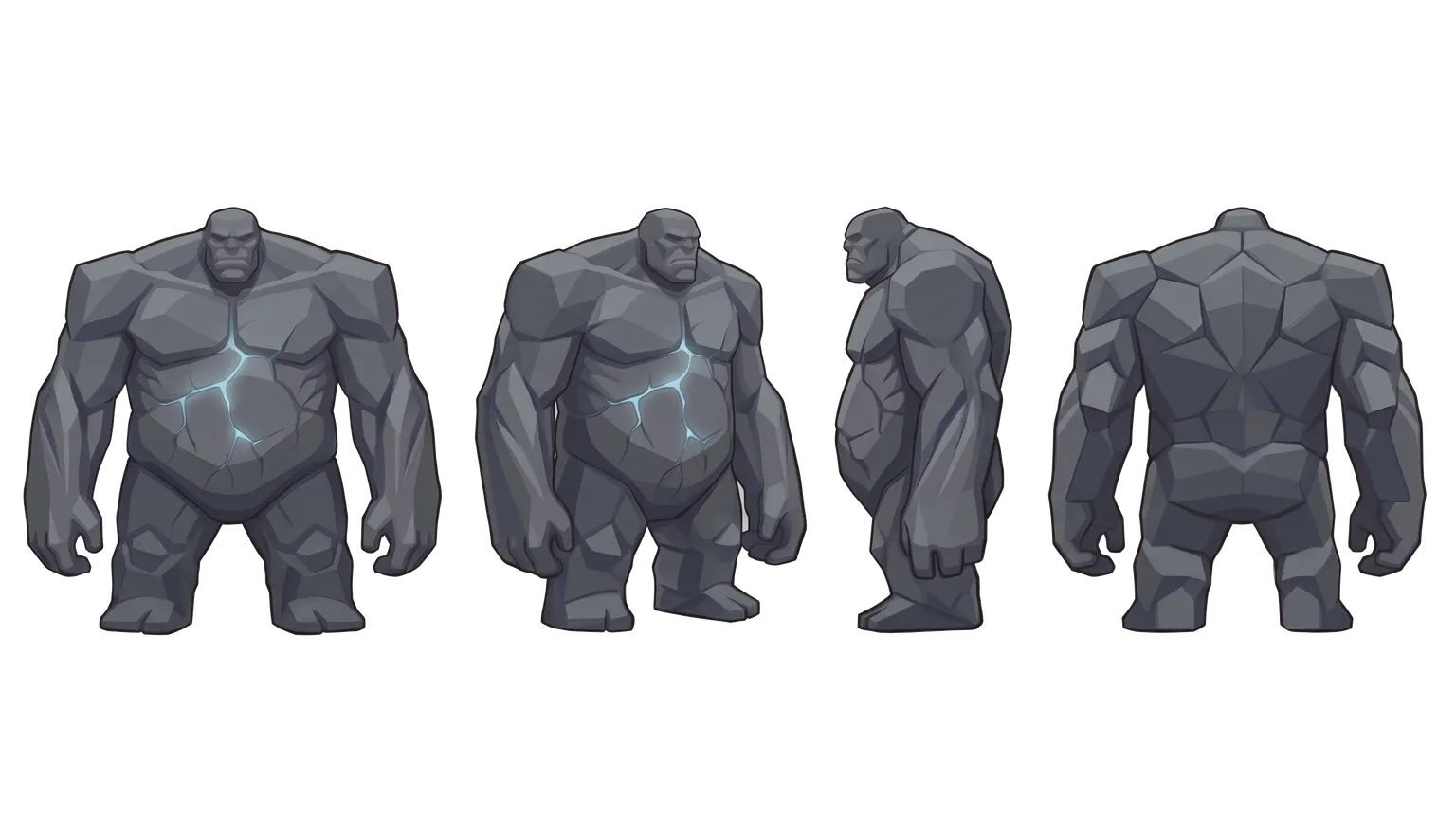
At the very top of this post you can see the Hrímthurs, the oldest being in the game. These rime giants were already sleeping in the ice long before there were any people in the north to give them a name. The eclipse did not recruit them — it merely woke them up. That is the defining trait of this layer: the giant is not marching on Rimehold because the ice told him to. He set off because he is awake now, and the tower happens to be standing in his way.
You can see it very clearly in the way he fights, because he barely registers you as a player at all. His only target is the tower. You can stand in front of him, attack him from behind, hit him without a break — he will not so much as turn around. To him you are just a little man with an axe, while he is a piece of the landscape that has come to life. He only becomes a problem once he reaches the walls, because then he tears them down. So you end up spending every resource you have on an enemy that never looked at you once.
The glowing cracks on his chest were really just my practical solution to a readability problem while drawing: with a top-down camera over bright snow, silhouettes read better than faces. But in the end that design carries the core idea of the monster far better than his pose ever could. Something deep inside him, older than the north itself, is shining out through all that solid stone.
The Jötunn belongs to this layer too. Since I have not drawn any artwork for him yet, he will get his own post later on. His special rule is this: when he shows up, everything suddenly goes dead quiet.
What the ice brings back
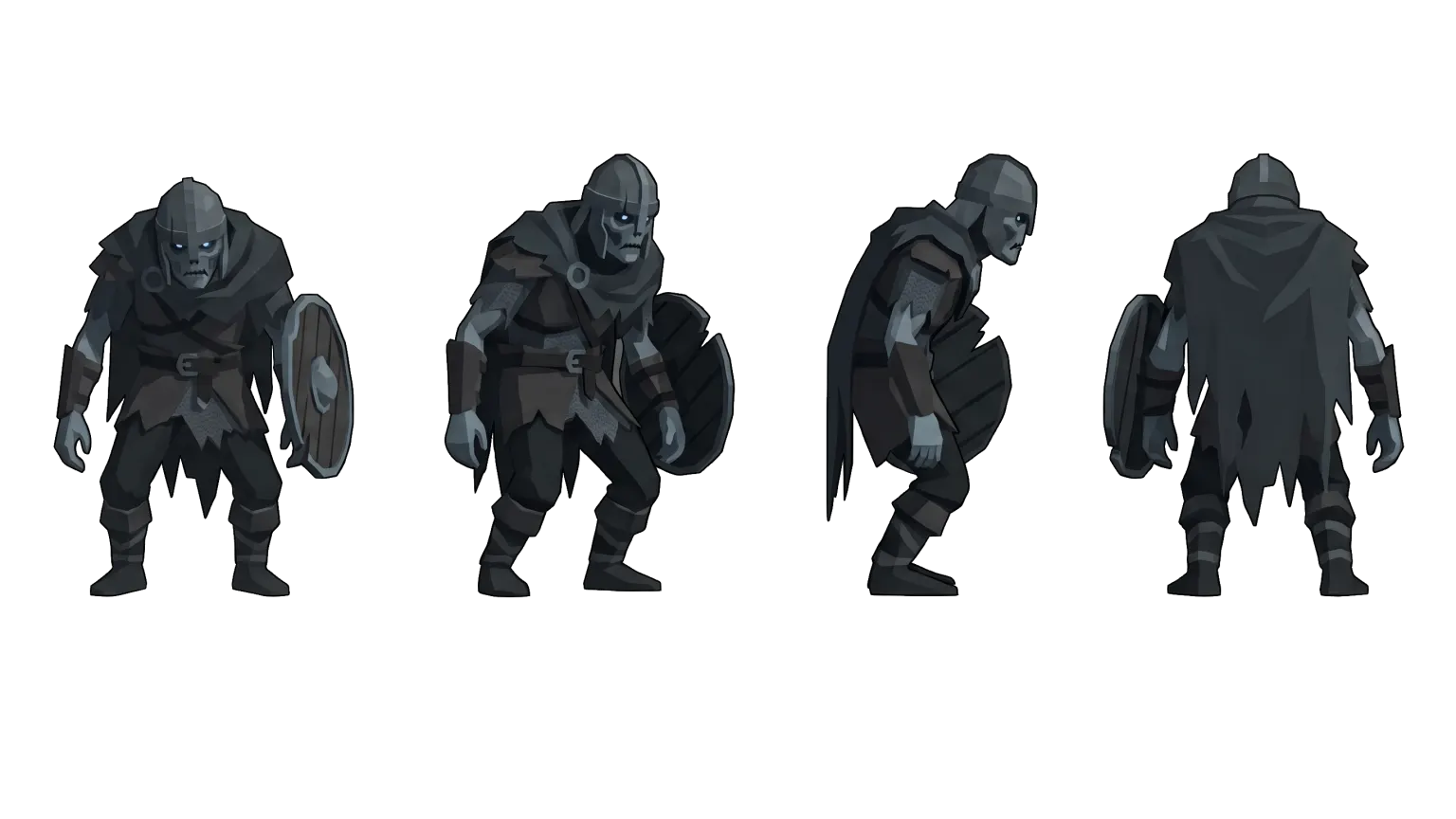
The Draugr are Rimehold’s own fallen warriors.
That is their whole story, and it is the only element in the game that is genuinely personal. The tower of Rimehold was being defended long before you ever got there. For generations, warriors have stood on that wall, died on it, and been buried where they fell — in the middle of the ice. Now the enemy they fought has pushed far enough south to reach them, and it makes them stand up again. They are still wearing the same mail, the same round shields, the same equipment the outpost has been issuing for ages, because it is literally the same equipment. They know this tower. They once helped defend it. And now they are hammering on its walls themselves. The last group of defenders to march up here is also the group the man you play arrived with, and his own story now has a post of its own.
The Draugr are the standard enemy. You will see them more often than any other, and that was exactly my intention: the tragic one should feel like constant background noise. They attack whatever is closest to them — you or the walls, depending on where you are standing. They pour down the corridors in numbers and form ragged lines without any real system behind it.
With them I stick strictly to one rule, and it is the reason I had to throw out an earlier version of the tower completely: there are two sources of the dead in this world, and they never overlap. The ice takes the ones who fell here and turns them into Draugr. Odin takes the souls he claims for himself and turns them into Einherjar — and it is out of what they leave behind that you build the tower, piece by piece. Nobody gets counted twice. That contrast is the central statement of the game: nobody is allowed to stay dead, and the tower is the only thing still standing once both sides are finished with each other.
What the ice shapes out of itself
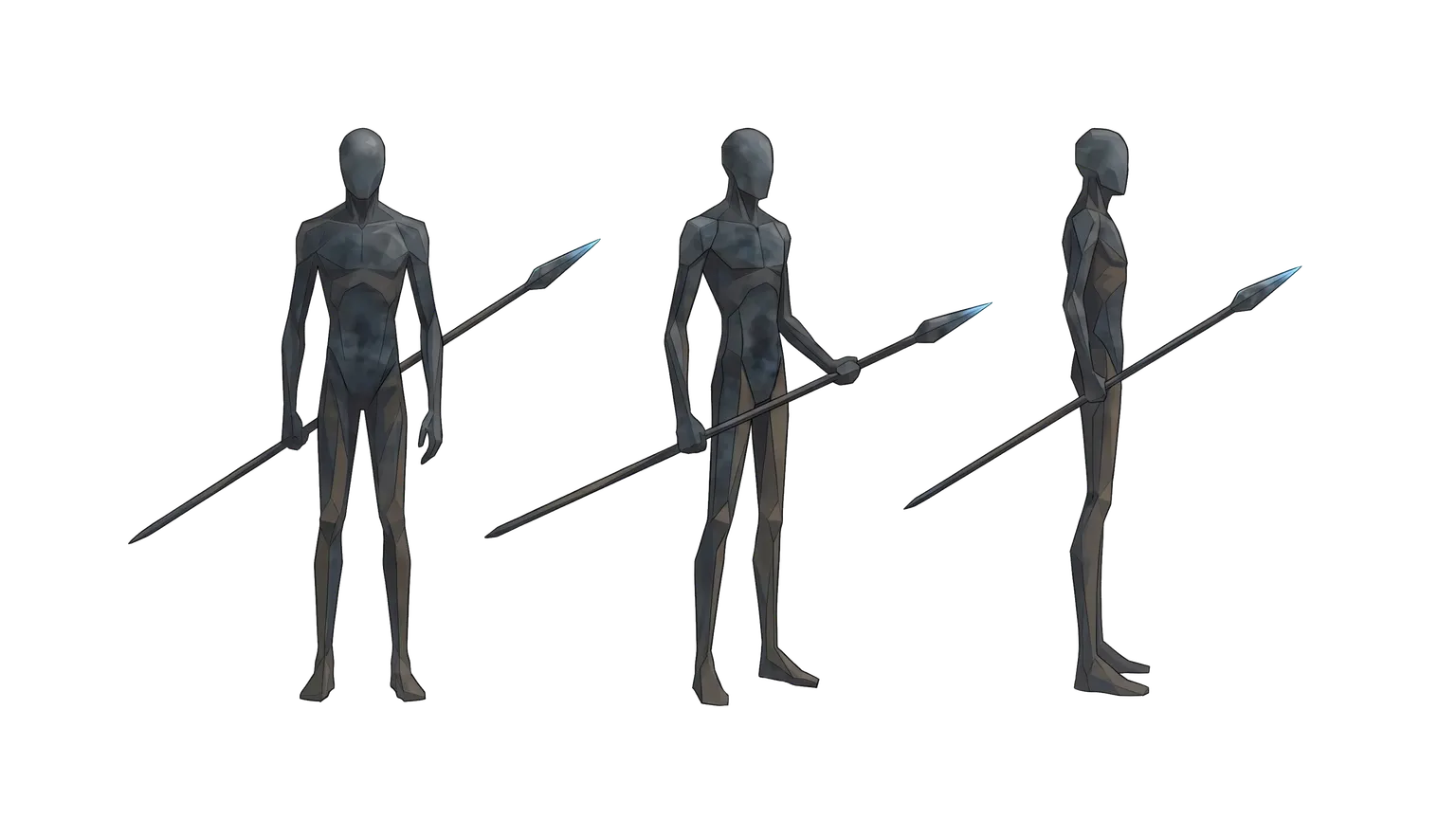
The Icespearman has no origin story — and that is not an oversight on my part.
The first two layers consist of creatures that were once alive, or at least existed before the ice found them. This enemy did not. He is pure ice that has taken on a shape, and that shape happens to roughly resemble a man with a spear. There is nothing behind the face, because there is no face. Nothing ever slept inside him, and nobody was ever buried there. He is my proof that the ice is not simply growing, but acting with purpose. That makes him unsettling rather than sad, because there is quite simply nobody inside him to mourn.
He throws a splinter of himself, and he keeps his distance while doing it — further out than any other enemy in the game. That lets him work on the tower from a range where you would never go looking for enemies in the first place. Every other enemy comes to you eventually; this one does not. Mechanically that forces you to move away from your own protective walls, which is also the main reason I designed him at all.
The larva of Nidhöggr belongs to this layer as well: she stays flat to the ground, keeps safely to the back, and breeds. I have not drawn any artwork for her yet either.
The enemy that does not work for the ice
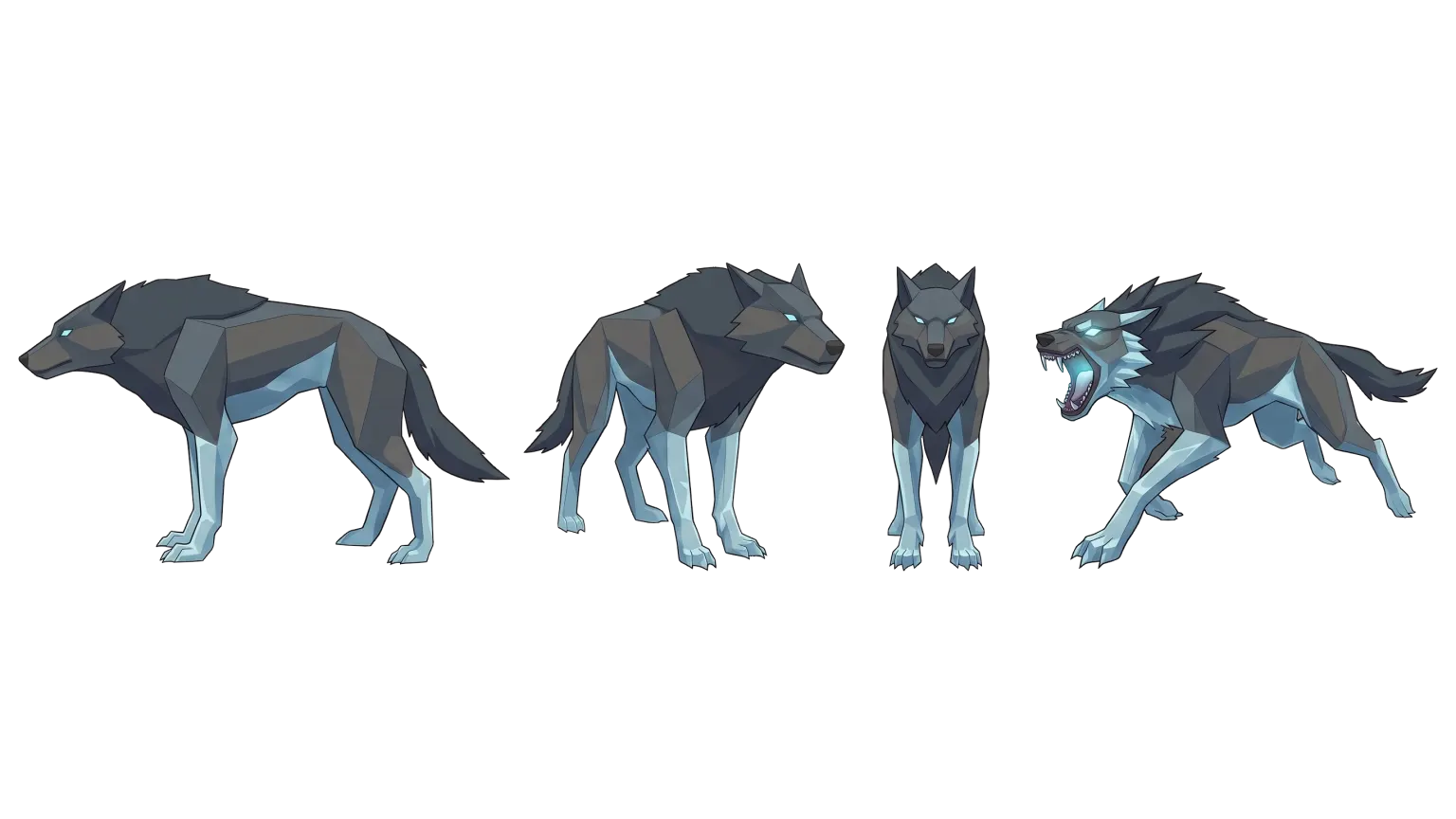
So far, everything on this list either serves the ice or was driven ahead of it. Neither applies to the Fenrir brood. They are the descendants of the great wolf Fenrir, and they have always lived out there. They are only coming south with the cold because it opened the roads for them — not because anyone called them.
They are the only enemies in the game with a clear motive, and that motive is you. Not the tower. They run straight past it. They will ignore fights that have nothing to do with them just to reach the one thing on the battlefield that interests them: the walking dead man in the snow who carries a god’s favour. They can smell the Einheri. To them you are the perfect prey, the kind that never runs out, because you keep coming back after every death.
There is one detail about this that I like enormously, and I did not plan it — I only noticed it afterwards. Týr is one of the three gods who stand with you from the start. His greatest deed in the myths, the one he sacrificed his right hand for, was the binding of Fenrir. Týr’s ability in the game kills nothing; it binds a single enemy and holds it in place. So when the Fenrir brood turns up, the description “Týr binds the hunter” suddenly becomes an old debt being collected: the same god using the same method against the children of the wolf he once subdued.
While drawing the concept art I gave myself another iron rule here, and I will not be breaking it later: this is the only four-legged silhouette in the whole game. With a top-down camera you often have a tenth of a second to recognise a threat. As long as no other enemy runs on four legs, the instinctive signal “something is hunting me” is delivered by a clear shape rather than an icon, a colour, or a warning sound. That rule of the unambiguous silhouette matters more to me than any cool wolf variant I might dream up in the future.
What this actually is (and what it is not)
To be honest: four pieces of concept art often look like a lot more progress than there really is behind them.
None of it is in the game build yet. These are reference images for myself, for when I sit down to the 3D modelling later. On the way into the finished game every figure will inevitably lose detail, since you would not be able to make it out from that camera distance anyway. The Draugr and the Hrímthurs are playable in the upcoming demo. The spearman and the wolves are not; I will patch them in together later. They are arriving as a pair on purpose, because the spearman forces you away from the tower while the wolves punish you for exactly that — for leaving your cover. On its own, neither of them would really work. The larva has neither a 3D model nor artwork so far.
To sum it up: four out of six enemies are drawn but not yet modelled, while my demo is already coming out on 16 October. The next blog post will be about whichever of them makes the jump to a real 3D model first.
If you want to argue about any of this — especially about the three-layer rule, which will either hold the whole enemy design together brilliantly or quietly ruin it — then my Discord is the right place for it.